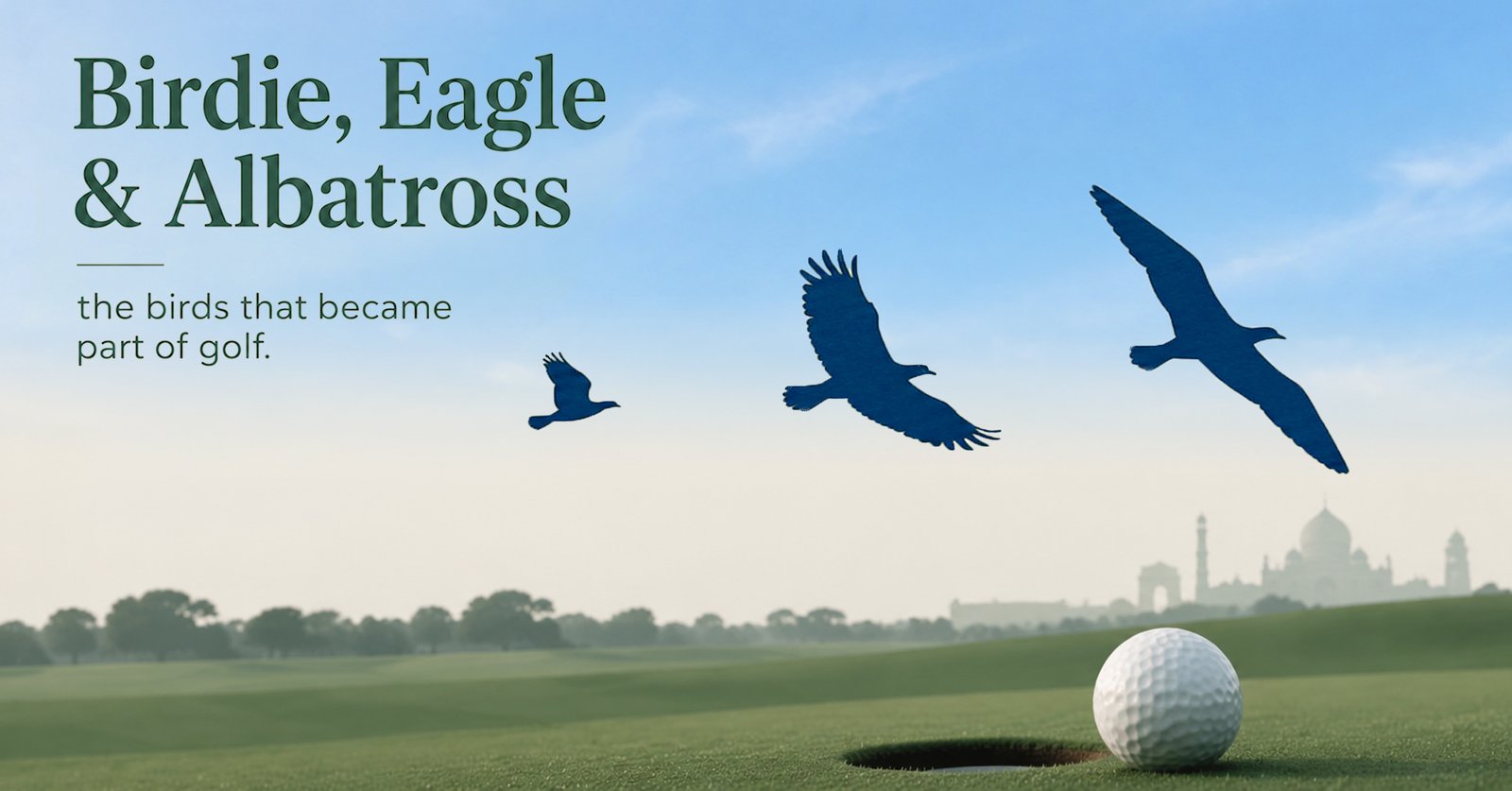
Golf has a language of its own. Par, bogey, birdie, eagle, albatross. Some of these words describe scores, while others sound as though they belong in a field guide.
But why did birds become part of golf?
The story begins with the birdie.
It Started With a Birdie
Today, a birdie means scoring one stroke under par on a hole. But the word has a rather colourful origin.
The term is believed to have emerged in the United States in the early 20th century. One popular story traces it to the Atlantic City Country Club in New Jersey, where golfers reportedly used the word “bird” as slang for something excellent or impressive. A particularly good shot was described as a “bird,” and a score under par eventually became a birdie.
Whatever the exact origin, the word caught on.
And golf had found its first bird.
Then Came the Eagle
If one under par was a birdie, golf needed something bigger for an even better score.
Enter the eagle.
An eagle is two strokes under par. The name follows a simple idea: if a birdie was good, an eagle had to be something considerably more impressive.
The term became popular in American golf during the 1920s and gradually became part of golf’s international vocabulary.
A par-5 finished in three strokes? That’s an eagle.
A par-4 reached in two? Also an eagle.
For golfers, the eagle is one of those moments that can change the entire feeling of a round. A single great hole can suddenly turn an ordinary scorecard into a memorable one.
And Then, Something Even Rarer
But what do you call three strokes under par?
Golf went looking for a bird even more extraordinary than an eagle.
The answer was the albatross.
An albatross, also known as a double eagle, is one of golf’s rarest achievements: three strokes under par on a single hole.
On a par-5, that means finishing in just two shots.
The name is fitting. The albatross is one of the world’s largest flying birds and is famous for its remarkable ability to glide enormous distances across the ocean. In golf, the word represents something equally extraordinary.
An albatross isn’t simply a good hole.
It’s a golfing story you’ll probably tell for years.
From Birds to a Language of Golf
What makes these terms fascinating is that they aren’t just numbers.
They give personality to the scorecard.
Birdie feels quick and rewarding.
Eagle feels powerful and rare.
Albatross feels almost mythical.
Together, they have become part of the culture and vocabulary of golf, turning simple scoring differences into expressions that golfers around the world instantly understand.
And perhaps that’s one of the beautiful things about golf. The sport can take something as simple as counting strokes and turn it into a language filled with history, tradition and character.
So the next time you mark a birdie on your card, celebrate an eagle, or hear someone recount an albatross, remember: you’re not just talking about a score.
You’re using a little piece of golf’s history.
And somewhere along the way, a few remarkable birds found a permanent home on the golf course.